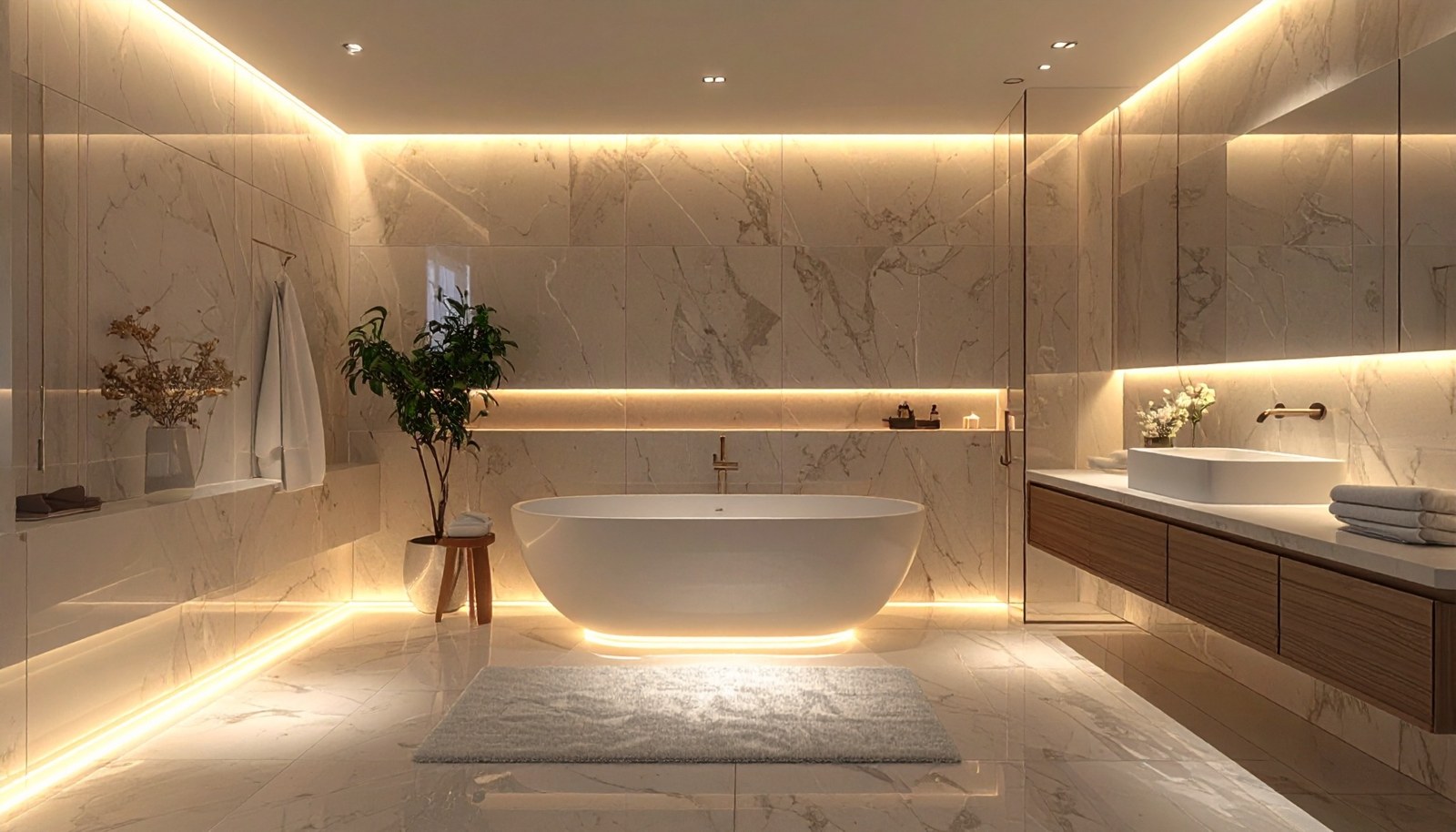
A well-lit bathroom should make the morning routine easy and feel welcoming at the end of the day. The best results come from choosing where light is needed, how it reaches you and which details deserve a softer glow.
Ideas & practical advice · 4 min read
Design inspiration
Three layers that work together
Light for the whole room
Ceiling lights provide the everyday illumination you need to move around, use the shower and clean the bathroom. Their position matters: a few well-placed fittings can work better than a ceiling full of bright spots.
Enlarge ↗
1 / 2 · Design inspiration
Light where you need to see clearly
At the mirror, light should reach your face rather than fall only from above. Lights beside the mirror or a suitably designed illuminated mirror can reduce distracting shadows when shaving or applying makeup.
A glow behind the mirror may look beautiful without providing enough light for your face. Check what the mirror actually illuminates, not just how it looks in a photograph.
Enlarge ↗
1 / 5 · Design inspiration
Light that creates atmosphere
A softly lit niche, a glow beneath a floating vanity or concealed light along a wall can bring depth to the room. Choose a small number of details to highlight so the lighting supports the design rather than competing with it.
Accent lighting complements the practical lighting; it should not leave the room too dark for everyday use.
Enlarge ↗
1 / 4 · Design inspiration
Warm or neutral white?
Warm white, often around 2700–3000 K, can create a softer evening atmosphere. Neutral white, around 4000 K, gives a different appearance that some people prefer for practical mirror lighting.
These are design choices, not legal requirements. A higher Kelvin number means a cooler colour—not automatically more brightness. Compare the options with your tiles, paint and fittings before choosing.
Colour rendering matters too: it describes how faithfully colours appear under the light. At the mirror, good colour rendering helps you judge skin tones and makeup; throughout the room it helps materials look as intended.
Enlarge ↗
1 / 2 · Design inspiration
These photographs illustrate different atmospheres; they are not a measured colour-temperature comparison.
Control the mood
Separate controls let you use the mirror, main lights and accent lighting independently. Compatible dimming can make the same bathroom feel clear and practical in the morning, then softer in the evening.
Plan the controls before the wiring is installed. LED fittings, drivers and dimmers need to work together, and drivers should be positioned with future maintenance in mind.
Comfortable light, carefully finished
Bright reflections in polished tiles, glare from an exposed LED strip and a spotlight directly over your face can all make a beautiful room less comfortable.
Consider diffusers, concealed positions and where the light will fall. A neat recess and a continuous-looking line of light depend on the profile, diffuser and LED arrangement—not just the strip itself.
Enlarge ↗
1 / 1 · Design inspiration
Illustrative linear-lighting detail; the image does not establish suitability for wet areas.
Safety near baths and showers
In Spain, the REBT electrical regulations include specific rules for rooms containing a bath or shower, in ITC-BT-27. The permitted equipment and protection requirements depend on its position within the defined bathroom zones.
An IP rating alone does not establish that a fitting is suitable for a particular location. The equipment, electrical protection and installation must be assessed together. Electrical work should be carried out by an authorised electrical installer under the applicable requirements.
At Morfohouse, lighting is considered alongside the layout, mirror, tiles and storage. SimpliPlan renders can help you explore the intended atmosphere; the final choice also depends on the fittings’ specifications and real material samples.
Iluminación del baño: luz práctica, ambiente cuidado
Un baño bien iluminado facilita la rutina de la mañana y resulta acogedor al terminar el día. El buen resultado empieza por decidir dónde hace falta luz, cómo llega hasta ti y qué detalles merecen una iluminación más suave.
Ideas y consejos prácticos · 4 min de lectura
Inspiración de diseño
Tres tipos de luz que se complementan
Luz para todo el baño
La iluminación del techo permite moverse, utilizar la ducha y limpiar el baño con comodidad. Su posición importa: unas pocas luminarias bien situadas pueden funcionar mejor que un techo lleno de focos intensos.
Ampliar ↗
1 / 2 · Inspiración de diseño
Luz donde necesitas ver con claridad
En el espejo, la luz debe llegar al rostro, no únicamente desde arriba. Los apliques a los lados o un espejo iluminado bien diseñado pueden reducir las sombras molestas al afeitarse o maquillarse.
La luz detrás del espejo puede crear un efecto bonito sin iluminar suficientemente la cara. Conviene comprobar qué ilumina realmente el espejo, además de su aspecto en una fotografía.
Ampliar ↗
1 / 5 · Inspiración de diseño
Luz para crear ambiente
Una hornacina iluminada, una luz bajo un mueble suspendido o una línea oculta junto a una pared pueden aportar profundidad al espacio. Elegir pocos detalles permite que la iluminación acompañe al diseño sin competir con él.
La iluminación decorativa complementa a la práctica; no debe dejar el baño demasiado oscuro para su uso diario.
Ampliar ↗
1 / 4 · Inspiración de diseño
¿Blanco cálido o neutro?
El blanco cálido, habitualmente alrededor de 2700–3000 K, puede crear un ambiente más suave por la noche. El blanco neutro, alrededor de 4000 K, ofrece un aspecto distinto que algunas personas prefieren para la iluminación práctica del espejo.
Son decisiones de diseño, no exigencias legales. Un valor Kelvin más alto significa un tono más frío, no necesariamente más intensidad. Conviene comparar las opciones con las baldosas, la pintura y la grifería antes de elegir.
También importa la reproducción cromática: describe la fidelidad con la que se ven los colores bajo esa luz. En el espejo ayuda a valorar los tonos de piel y el maquillaje; en el resto del baño permite apreciar mejor los materiales.
Ampliar ↗
1 / 2 · Inspiración de diseño
Las fotografías muestran ambientes distintos; no son una comparación medida de temperatura de color.
Controla el ambiente
Los controles separados permiten utilizar el espejo, la iluminación general y la decorativa de forma independiente. Una regulación de intensidad compatible permite que el mismo baño sea práctico por la mañana y más suave al llegar la noche.
Los controles deben planificarse antes de instalar el cableado. Las luminarias LED, sus fuentes de alimentación y los reguladores deben ser compatibles. También hay que prever el acceso a las fuentes de alimentación para su mantenimiento.
Luz cómoda y remates cuidados
Los reflejos intensos sobre baldosas pulidas, el deslumbramiento de una tira LED expuesta o un foco directamente sobre la cara pueden restar comodidad a un baño atractivo.
Hay que considerar los difusores, las posiciones ocultas y el recorrido de la luz. Un alojamiento limpio y una línea de luz visualmente continua dependen del perfil, el difusor y la distribución de los LED, no solo de la tira.
Ampliar ↗
1 / 1 · Inspiración de diseño
Detalle ilustrativo de iluminación lineal; la imagen no acredita su idoneidad para zonas húmedas.
Seguridad cerca de bañeras y duchas
En España, el Reglamento Electrotécnico para Baja Tensión incluye requisitos específicos para los locales con bañera o ducha en la ITC-BT-27. Los equipos permitidos y las protecciones necesarias dependen de su posición en los volúmenes definidos para el baño.
El grado IP, por sí solo, no demuestra que una luminaria sea adecuada para una ubicación concreta. Deben valorarse conjuntamente el equipo, las protecciones eléctricas y la instalación. Los trabajos eléctricos deben realizarlos instaladores eléctricos habilitados conforme a los requisitos aplicables.
En Morfohouse, la iluminación se estudia junto con la distribución, el espejo, las baldosas y el almacenaje. Los renders de SimpliPlan ayudan a explorar el ambiente previsto; la elección final también depende de las características de las luminarias y de las muestras reales de los materiales.